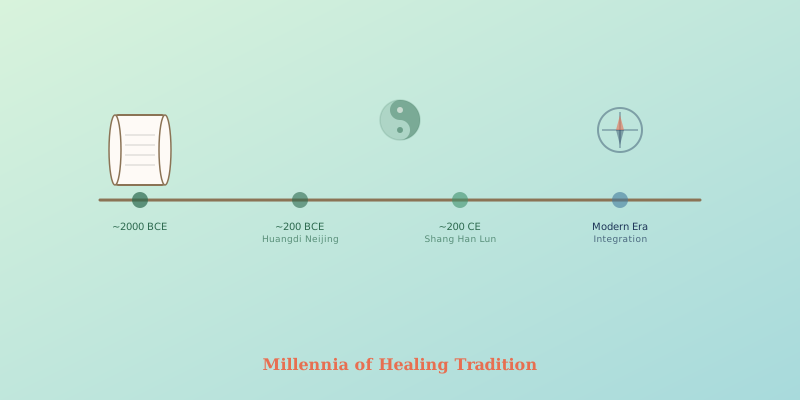
Both TCM and Western medicine have histories stretching back thousands of years. Tracing them in parallel reveals striking convergences and divergences — moments where both traditions grappled with the same questions about human health, often arriving at different but equally remarkable answers.
Ancient Foundations (Before 200 CE)
Eastern Milestones
- ~1600 BCE: Shang dynasty oracle bones contain early references to disease and healing rituals
- ~300–100 BCE: Huangdi Neijing (Yellow Emperor's Classic of Internal Medicine) — foundational text establishing Qi, Yin-Yang, Five Elements, and meridian theory
- ~200 BCE: Shennong Bencao Jing (Divine Farmer's Materia Medica) — first systematic herbal pharmacopoeia listing 365 substances
- ~200 CE: Zhang Zhongjing writes Shanghan Lun (Treatise on Cold Damage Disorders) — still used clinically today
Western Milestones
- ~1550 BCE: Ebers Papyrus (Egypt) — early medical text with herbal remedies and surgical descriptions
- ~400 BCE: Hippocrates establishes medicine as a rational discipline, separating it from supernatural explanations. Humoral theory (blood, phlegm, yellow bile, black bile)
- ~170 CE: Galen systematises Greek medical knowledge, emphasising anatomy through animal dissection. His works dominate Western medicine for 1,300 years
The Middle Period (200–1500 CE)
In China: TCM continued to develop with remarkable sophistication. Sun Simiao (581–682 CE), often called the "King of Medicine," wrote Qian Jin Yao Fang (Essential Prescriptions Worth a Thousand Gold), emphasising medical ethics and comprehensive clinical formulas. Li Shizhen (1518–1593) compiled the monumental Bencao Gangmu (Compendium of Materia Medica), documenting 1,892 substances — a pharmacological encyclopaedia that took 27 years to write.
In the West: After the fall of Rome, medical knowledge was preserved and advanced by Islamic scholars. Avicenna (Ibn Sina, 980–1037) wrote The Canon of Medicine, which synthesised Greek and Islamic medical knowledge and served as the primary Western medical textbook for 500 years. European medicine remained largely stagnant during this period, constrained by religious authority and Galenic orthodoxy.
The Great Divergence (1500–1900)
This is where the paths diverge dramatically. Western medicine underwent a scientific revolution; TCM continued to refine its classical framework.
Western Breakthroughs
- 1543: Andreas Vesalius publishes De Humani Corporis Fabrica, correcting centuries of anatomical errors through human dissection.
- 1628: William Harvey demonstrates blood circulation, overturning Galenic physiology.
- 1796: Edward Jenner develops the smallpox vaccine — the foundation of immunology.
- 1846: Anaesthesia makes surgery survivable.
- 1861: Louis Pasteur establishes germ theory.
- 1865: Joseph Lister introduces antiseptic surgery.
- 1895: X-rays discovered by Wilhelm Röntgen — medical imaging begins.
- 1928: Alexander Fleming discovers penicillin — the antibiotic era begins.
TCM During This Period
TCM did not undergo an equivalent revolution. Instead, it continued to refine pattern diagnosis, develop new herbal formulas, and train practitioners through apprenticeship. The Warm Disease school (Wen Bing) emerged in the 17th–18th centuries, developing more nuanced approaches to infectious febrile diseases — a response to epidemics that parallels (but differs from) Western germ theory. TCM's strength during this period was its continuity and accumulated clinical experience; its limitation was the absence of microscopy, chemistry, and controlled experimentation.
The Modern Era (1900–Present)
Western medicine accelerated dramatically: antibiotics, organ transplants, DNA discovery, CT scans, MRI, chemotherapy, immunotherapy, gene therapy, and mRNA vaccines. It became the dominant global medical system.
TCM faced an existential crisis. In the early 20th century, Chinese reformers debated abolishing TCM entirely in favour of Western science. In 1929, a motion to ban TCM practice was proposed (and narrowly defeated). After the 1949 Communist revolution, Mao Zedong — for both pragmatic and ideological reasons — promoted TCM as part of national healthcare, establishing TCM universities and research institutions. This political support preserved and systematised TCM, but also politicised it.
Since the 1970s, TCM has increasingly engaged with Western research methods. Tu Youyou's discovery of artemisinin (1971) stands as the defining bridge between the traditions. Today, TCM is studied in universities worldwide, and acupuncture is practised in over 180 countries.
Convergence in the 21st Century
After centuries of divergence, the two traditions are converging again. Western systems biology echoes TCM holism. Network pharmacology validates multi-compound herbal approaches. Integrative medicine programmes combine both traditions in clinical practice. The WHO included TCM diagnostic categories in the ICD-11 (2019). The history of medicine suggests not two separate stories, but a single story of humanity's quest to understand health and healing — told in two different languages that are slowly learning to speak to each other.
Key Takeaway
TCM and Western medicine share ancient roots in the desire to heal, then diverged dramatically during the scientific revolution. Western medicine gained unparalleled power through reductionist science; TCM preserved unparalleled depth in holistic patient care. The 21st century may be remembered as the era when these two great traditions finally began to learn from each other systematically.