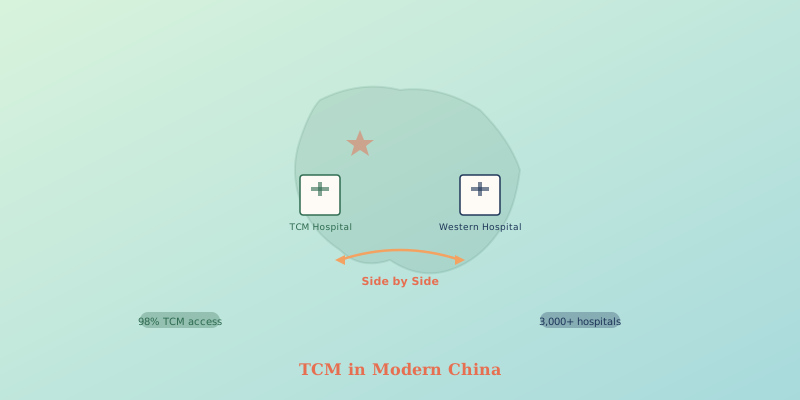
China is the only major country where Traditional Chinese Medicine and Western medicine operate as parallel, officially equal healthcare systems. Understanding how this works in practice — its strengths, its politics, and its contradictions — offers lessons for the rest of the world.
The Dual System
China maintains two parallel networks of healthcare institutions:
- Western medicine hospitals (Xi Yi Yuan) — equipped with modern technology, operating theatres, and pharmaceutical dispensaries. They function much like hospitals in any developed country.
- TCM hospitals (Zhong Yi Yuan) — staffed by TCM-trained physicians who diagnose using pattern differentiation and treat with acupuncture, herbal medicine, tuina, and other traditional methods. However, these hospitals also have imaging equipment, laboratories, and Western pharmacy departments.
In practice, the line between the two is blurry. Most TCM hospitals use Western diagnostics (blood tests, CT scans) alongside TCM methods. Many Western hospitals have TCM departments. Patients frequently use both systems for the same condition — seeing a Western doctor for diagnosis and a TCM doctor for ongoing management.
Government Policy
TCM's survival and growth in modern China owes much to political support:
- Mao Zedong (1950s–1970s): Promoted TCM as a practical solution for healthcare in rural areas where Western doctors were scarce, and as a symbol of national identity. Established the first TCM universities and research institutes. Required Western-trained doctors to study TCM (though TCM practitioners also studied Western basics).
- 2016 TCM Law: China's first comprehensive law on Traditional Chinese Medicine elevated TCM to equal legal status with Western medicine, mandated TCM departments in general hospitals, and increased government funding for TCM research and education.
- Belt and Road Initiative: China has used BRI partnerships to promote TCM internationally, establishing TCM centres in over 30 countries.
- COVID-19 response: TCM was officially incorporated into China's national COVID-19 treatment protocols. Over 90% of Chinese COVID-19 patients reportedly received some form of TCM treatment alongside conventional care.
TCM Education
China has over 40 dedicated TCM universities and colleges. The standard programme is a 5-year bachelor's degree that includes both TCM and Western biomedical sciences (anatomy, physiology, biochemistry, pathology). Students study classical texts alongside modern pharmacology. Many pursue master's and doctoral degrees in TCM-related research. Notable institutions include Beijing University of Chinese Medicine, Shanghai University of Traditional Chinese Medicine, and Guangzhou University of Chinese Medicine.
How Chinese Patients Navigate Both Systems
Surveys consistently show that Chinese patients use both systems pragmatically:
- For acute conditions, infections, and emergencies, most prefer Western medicine.
- For chronic conditions, recovery, and "constitutional" health, many prefer TCM.
- For cancer, the majority use both — Western treatment for the tumour, TCM for side effect management and recovery.
- Younger, urban, educated Chinese increasingly favour Western medicine, while older and rural populations lean more toward TCM — though the picture is complex and evolving.
Criticisms and Controversies
China's promotion of TCM is not without controversy:
- Political influence on science: Critics argue that government support sometimes shields TCM from rigorous scientific scrutiny. Research quality standards at some Chinese institutions remain lower than international norms.
- Publication bias: The near-universal positivity of Chinese TCM trial results (often exceeding 99% positive outcomes) raises concerns about selective reporting.
- Economic interests: The TCM industry in China is worth over $100 billion annually, creating financial incentives that may conflict with objective evaluation.
- Wildlife conservation: Despite reforms, the use of endangered animal products in some TCM products remains a conservation concern.
- Internal debate: Many Chinese scientists and physicians have publicly criticised the political promotion of TCM, arguing that medical treatments should be evaluated on evidence alone, regardless of cultural origin.
International Recognition: WHO and ICD-11
In 2019, the World Health Organization included a chapter on Traditional Medicine conditions in the ICD-11 (International Classification of Diseases, 11th Revision). This was a landmark moment — it means TCM diagnostic categories now have international codes that can be used in medical records worldwide. Supporters see this as validation; critics worry it confers legitimacy without sufficient evidence. The debate reflects the broader tension between recognising traditional medicine's historical contribution and holding all medical systems to the same evidence standards.
Lessons for the World
China's dual system demonstrates that TCM and Western medicine can coexist within a single healthcare framework. The system is imperfect — political interference, quality inconsistencies, and evidence gaps remain real issues. But the core insight is valuable: patients benefit from having access to both traditions, used intelligently and with professional coordination. Other countries are watching China's experiment closely as they consider how to integrate traditional medicine into their own healthcare systems.
Key Takeaway
China operates the world's largest experiment in medical integration, with TCM and Western medicine available side by side to over a billion people. The model offers both inspiration (access, patient choice, complementary care) and cautionary lessons (political influence on science, publication bias, conservation concerns). The global movement toward integrative medicine owes much to the Chinese example — warts and all.