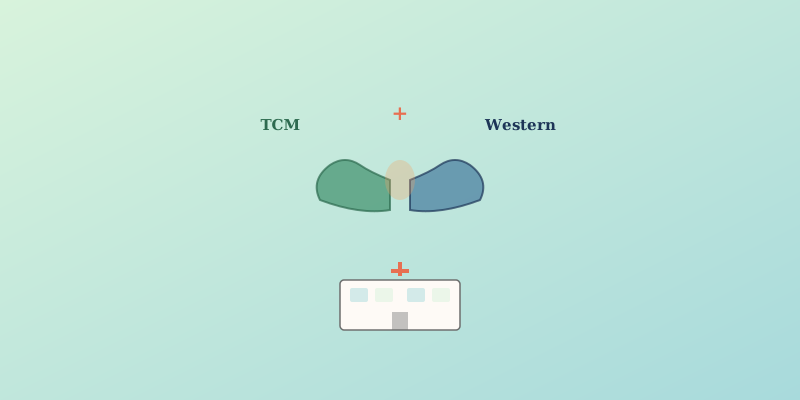
Integrative medicine is not "alternative medicine rebranded." It is a deliberate, evidence-informed approach that combines the best of conventional and traditional medicine, coordinated by professionals who communicate with each other and place the patient at the centre. Around the world, leading medical institutions are building integrative programmes — and the results are reshaping how we think about healthcare delivery.
What Integrative Medicine Actually Means
The Academic Consortium for Integrative Medicine and Health defines it as: "The practice of medicine that reaffirms the importance of the relationship between practitioner and patient, focuses on the whole person, is informed by evidence, and makes use of all appropriate therapeutic and lifestyle approaches, healthcare professionals, and disciplines to achieve optimal health and healing."
Key principles include: using evidence to guide decisions (not ideology), treating the whole person, prioritising prevention, and building a therapeutic partnership where the patient is an active participant.
Models Around the World
China: The Dual-System Hospital
China operates the most extensive integrative model. Major hospitals maintain separate TCM and Western medicine departments under one roof. Patients can be referred between departments, and for many conditions — particularly chronic diseases, cancer support, and rehabilitation — treatment plans combine both systems. TCM universities train practitioners in both Western biomedical science and traditional methods. The Chinese government actively promotes "integrated Chinese-Western medicine" (Zhong Xi Yi Jie He) as a national healthcare strategy.
United States: Academic Medical Centres
Over 70 US academic medical centres now have integrative medicine programmes. Notable examples include the Osher Center at UCSF and Harvard, the Andrew Weil Center at the University of Arizona, and Memorial Sloan Kettering's Integrative Medicine Service. These typically offer acupuncture, massage, mind-body therapies, and nutrition counselling alongside conventional treatments. The focus is particularly strong in oncology, pain management, and women's health.
Germany and Europe
Germany has a long tradition of Naturheilkunde (natural medicine) and is a global leader in acupuncture research. Many German statutory health insurance plans cover acupuncture for chronic low back pain and knee osteoarthritis following positive large-scale trials (ART and GERAC studies). The Charité University Hospital in Berlin operates a respected integrative medicine department.
Australia
Australia regulates Chinese medicine practitioners through the Australian Health Practitioner Regulation Agency (AHPRA) — making it one of the few Western countries with statutory registration for TCM. The Royal Melbourne Institute of Technology (RMIT) offers accredited TCM degree programmes. Integration is occurring primarily in private practice and some hospital pain clinics.
What Patients Experience
In a well-run integrative clinic, a patient might experience:
- Comprehensive intake: Both Western and TCM assessments are conducted, creating a complete picture of the patient's health.
- Coordinated treatment plan: The team reviews both conventional medications and TCM treatments together, checking for interactions and ensuring coherence.
- Evidence-based selection: TCM modalities are recommended where evidence supports them — not for everything indiscriminately.
- Shared records: Both Western and TCM practitioners document in the same medical record, ensuring continuity.
- Outcome tracking: Patient-reported outcomes, functional measures, and quality of life are tracked alongside biomarkers.
Benefits of Integration
- Reduced medication dependence: Patients using acupuncture for pain often reduce opioid and NSAID use.
- Improved patient satisfaction: Studies consistently show higher satisfaction scores in integrative programmes.
- Better chronic disease management: Addressing lifestyle, diet, stress, and constitution alongside pharmacotherapy produces more durable improvements.
- Safety through coordination: When both practitioners communicate, herb-drug interaction risks are identified and managed proactively.
Challenges and Criticisms
- Evidence gaps: Not all TCM modalities offered in integrative settings have strong RCT support. Sceptics argue this lowers the evidence bar.
- Communication barriers: TCM and Western practitioners use different conceptual languages, which can impede collaboration.
- Training asymmetry: TCM practitioners study Western biomedical science, but Western doctors rarely study TCM, creating an imbalanced understanding.
- Insurance coverage: Integrative services are often not fully covered, limiting access to those who can afford out-of-pocket costs.
The Future of Integrative Care
The global trend is unmistakable: integrative medicine is growing in every region. The WHO's Traditional Medicine Strategy 2014–2023 (extended to 2025) called on member states to integrate traditional medicine into national health systems where appropriate. As evidence accumulates and training programmes improve, the vision of coordinated, whole-person care that draws on both Eastern and Western traditions is becoming mainstream reality — not as a compromise, but as an upgrade.
Key Takeaway
Integrative medicine at its best is not "a bit of everything" — it is the strategic, evidence-informed combination of conventional and traditional approaches, coordinated by communicating professionals. If you are interested in this approach, look for programmes affiliated with academic medical centres or staffed by licensed practitioners of both traditions.