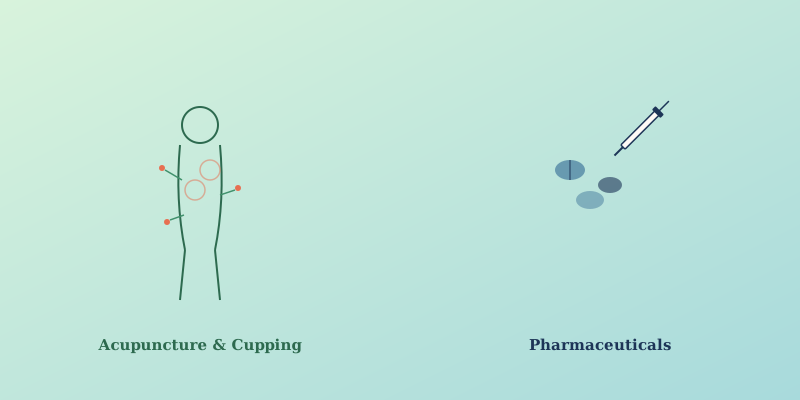
Pain is the most common reason people seek medical help worldwide, and it is also the condition where the divide — and the potential synergy — between TCM and Western medicine is most visible. Chronic pain alone affects an estimated 1.5 billion people globally. Both systems offer powerful tools, but they approach the problem from fundamentally different angles.
The TCM Approach to Pain
In TCM, pain is understood through a single governing principle: "Where there is blockage, there is pain; where there is free flow, there is no pain" (Bu tong ze tong, tong ze bu tong). Pain results from stagnation — of Qi, Blood, or both — often compounded by pathogenic factors like Cold, Dampness, or Heat.
Acupuncture
Acupuncture is TCM's most studied pain intervention. Fine needles inserted at specific points along meridians are believed to unblock Qi stagnation and stimulate the body's self-healing mechanisms. Modern research has identified several plausible mechanisms: release of endorphins and enkephalins, modulation of pain-signalling pathways, local anti-inflammatory effects, and changes in brain connectivity visible on fMRI. The evidence base is strongest for chronic low back pain, knee osteoarthritis, tension headache, and migraine, where multiple systematic reviews and meta-analyses show acupuncture outperforms sham controls and usual care.
Cupping Therapy
Cupping uses suction to draw blood flow to affected areas, promoting circulation and releasing myofascial tension. While research quality is mixed, cupping has shown promise for musculoskeletal pain, particularly in the neck and lower back. It is often used alongside acupuncture.
Tuina Massage
Tuina is a therapeutic massage system that works along meridians and acupressure points. It combines techniques similar to Western physiotherapy — kneading, rolling, pressing, and stretching — with TCM diagnostic principles. Tuina is commonly used for musculoskeletal pain, sports injuries, and tension headaches.
Herbal Analgesics
TCM herbal formulas for pain often contain herbs that modern pharmacology has confirmed possess analgesic properties. Corydalis (Yan Hu Suo) contains dehydrocorybulbine (DHCB), which has been shown to activate dopamine receptors and produce measurable pain relief in animal models. Other commonly used herbs include frankincense (Ru Xiang), myrrh (Mo Yao), and turmeric (Jiang Huang), all of which have documented anti-inflammatory properties.
Moxibustion
Burning dried mugwort (Ai Ye) near acupuncture points generates deep warmth that is thought to dispel Cold and promote Qi circulation. Moxibustion is particularly favoured for pain patterns associated with Cold-Damp — such as osteoarthritis that worsens in cold weather.
The Western Approach to Pain
Pharmaceutical Interventions
NSAIDs (ibuprofen, naproxen, diclofenac) block cyclooxygenase enzymes to reduce inflammation and pain. They are effective for acute and mild-to-moderate chronic pain but carry risks of gastrointestinal bleeding, kidney damage, and cardiovascular events with long-term use.
Opioids (morphine, oxycodone, fentanyl) bind to mu-opioid receptors to produce powerful analgesia. They are invaluable for acute post-surgical and cancer pain but have been at the centre of a devastating addiction epidemic. In the United States alone, opioid overdoses have claimed over 500,000 lives since 1999, prompting urgent calls for alternative pain strategies.
Corticosteroid injections deliver potent anti-inflammatory medication directly to joints or nerve roots. They provide rapid relief but have limited duration and cannot be repeated indefinitely due to tissue damage risks.
Physical Therapy
Structured exercise programmes, manual therapy, and modalities like TENS (transcutaneous electrical nerve stimulation) are first-line treatments for many musculoskeletal pain conditions. Evidence strongly supports physical therapy for low back pain, shoulder impingement, and post-surgical rehabilitation.
Interventional Procedures
Nerve blocks, radiofrequency ablation, spinal cord stimulators, and joint replacements offer options for severe or refractory pain. These are highly specialised, evidence-based interventions that TCM does not replicate.
Psychological Approaches
Cognitive-behavioural therapy (CBT) for chronic pain, acceptance and commitment therapy (ACT), and mindfulness-based stress reduction (MBSR) address the psychological dimensions of pain. Pain neuroscience education helps patients understand that chronic pain involves central sensitisation — the nervous system amplifying pain signals beyond what tissue damage warrants.
TCM Strengths in Pain
- Strong evidence for acupuncture in chronic pain conditions
- Minimal side effects and no addiction risk
- Addresses the individual's overall pattern, not just the symptom
- Multiple modalities can be combined (acupuncture + herbs + tuina)
- Particularly effective for functional and musculoskeletal pain
Western Strengths in Pain
- Rapid, powerful relief for acute and post-surgical pain
- Interventional procedures for severe structural problems
- Evidence-based physical therapy protocols
- Advanced imaging identifies treatable structural causes
- Psychological therapies address central sensitisation
The Opioid Crisis: A Turning Point
The opioid epidemic has created an unprecedented opening for non-pharmacological pain treatments. In 2017, the American College of Physicians recommended acupuncture as a first-line option for chronic low back pain — ahead of medications. The US Department of Veterans Affairs now offers acupuncture at many facilities. These policy shifts represent mainstream Western medicine acknowledging that its most powerful analgesics can cause more harm than good when misused, and that TCM modalities offer a genuinely valuable alternative for chronic pain.
How They Complement Each Other
The strongest pain management programmes use both systems strategically. Western diagnostics identify the structural cause (a herniated disc, a torn rotator cuff). If surgery is needed, Western medicine handles it. For the chronic, ongoing pain that often persists after structural repair — or when no structural cause is found — acupuncture, herbal medicine, and tuina can reduce reliance on pharmaceuticals, improve function, and enhance quality of life. Studies of integrative pain programmes at major medical centres consistently show reduced opioid use and improved patient satisfaction when acupuncture is added to standard care.
Key Takeaway
Western medicine excels at diagnosing the cause of pain and providing rapid relief in acute situations. TCM excels at managing chronic pain with minimal side effects. The opioid crisis has made the case for integration urgent — and the evidence increasingly supports using both systems together.